Tuesday, April 10, 2012

Airtel 4G: Bharti Airtel in talks to buy 4G licences from Qualcomm for about Rs 6000 crore


MUMBAI: Bharti Airtel is in advanced discussions with US chipmaker Qualcomm to buy its fourth-generation licences for about Rs 6,000 crore, an acquisition that will allow the country's largest telecom firm to quickly launch 4G services in the key markets of Delhi and Mumbai.
A person familiar with the development said the deal is likely to be closed by June and will be accompanied by technology agreements between Qualcomm and Bharti. Fourth-generation, or 4G, services offer users Internet access at three times the speed of 3G and require broadband airwaves.
Qualcomm, which had won airwaves in four regions - Mumbai, Delhi, Haryana and Kerala - in the broadband wireless auction of 2010 for Rs 4,900 crore, had begun talks to sell its 74% stake in its Indian joint venture to Bharti later that year.
But the talks were put on hold after the telecom department cancelled the US chipmaker's mobile broadband permits last year on the grounds that it had not applied for licences within three months of the auction.
The telecom department further alleged that Qualcomm applied for permits under the names of four different companies, violating auction guidelines that said winners could 'nominate only one company for obtaining a licence'.
But last month, the Telecom Disputes Settlement & Appellate Tribunal (TDSAT) ruled in favour of Qualcomm's India unit and the company is expected to receive spectrum in 10 days, paving the way for discussions to be revived and the transaction to possibly go ahead.
A Bharti Airtel spokesman said the company did not comment on market speculation while emails to the US company went unanswered. "The sale is Qualcomm's decision, we are not involved at this point," said HS Bedi, chairman and managing director of Tulip Telecom, one of Qualcomm's two JV partners in India.


saket kumar
pgdm2ndsem 
 

11 Apr, 2012, 10.34AM How Nokia has emerged as leader in crowded dual SIM market

One June afternoon last year, as the summer sun beat down mercilessly on scores of shoppers, a group of 200 bikers in bluecoloured uniforms waving blue flags descended on the narrow main market street of Azamgarh in Uttar Pradesh.

The deafening sound of crackers and dhols (drums), along with a group of bhangra dancers, made many believe that yet another political rally was afoot. This was no political procession though, but a 'Nokia Blue Brigade Rally' to announce the launch of the Finnish giant's dual-SIM handsets, a potent weapon conspicuous by its absence in the handset major's India arsenal.

Such systematic carpet bombing across the country has helped Nokia pull off something that was inconceivable a few years ago, to come from nowhere and claim a leadership position in the dual-SIM handset market. In the process, the iconic brand is fighting to regain ground it lost to multinational rivals as well as domestic Johnnie-Come-Latelys.

"We may have been late, but we have redefined the game," boasts Viral Oza, marketing director at Nokia India, who lets on that in the first month of launch, the company covered some 1.7 lakh Nokia outlets.

Nokia launched its first dual-SIM handset last June, two-and-a-half years after the likes of Micromax and Gfive made a splash. But in less than a year it has dethroned the first movers. According to Gfk, a market research firm, Nokia led with a 23% share in the dual-SIM segment in January 2012.

Samsung, GFive and Micromax followed with shares of 12.7%, 9.8% and 8.7%, respectively. Gfk pegs the market for dual-SIM handsets at 7.5 million in January of a total handset pie of 13.4 million units.

In 2010, shipments of multi-SIM handsets stood at close to 50 million, constituting a little over 30% of overall handset shipments, according to research and consulting firm Frost & Sullivan. That figure almost doubled last year, with the contribution of multi-SIM accounting for half of overall shipments.

Nokia 
 
 
saket kumar
pgdm2nd.sem.
 

Monday, April 9, 2012

weak dollar

Dollar that can be exchanged for only a small or decreasing amount of foreign currency. A weak dollar means that the U.S. dollar cannot buy very much of another currency. The strength of the dollar has an impact on imports and exports because goods and services from a foreign nation are usually purchased in the currency of the producing nation. A weak dollar usually leads to high exports and low imports. Opposite of strong dollar.

By:
Pushkar anand
PGDM 2nd. 

RBI must innovate to manage crunch

RBI must innovate to manage crunch
We are a week away from the Reserve Bank of India’s (RBI) annual monetary policy for fiscal 2013. Two sets of critical data—factory output for February and inflation in March—will be released before the policy, and both have a bearing on its theme. At this point, what is crystal clear is that partial devolvement of the year’s first bond auction is not a happy omen, and the Indian central bank will have a challenging year ahead grappling with tight liquidity and a record government borrowing.
File Photo
File Photo
RBI auctioned four lots of bonds worth Rs. 18,000 crore and there were no takers for about 7% at the cut-off price at which the central bank chose to sell them. They devolved on the primary dealers—those who buy and sell government bonds. According to RBI rules, if a bond auction is undersubscribed, an underwriter needs to subscribe to the remaining shares. Primary dealers play that role. The auction devolved partially and yields on bonds rose steeply despite the fact that RBI bought bonds through its so-called open market operations (OMO) just before the end of fiscal 2012 to infuse liquidity in the system, something the Indian central bank had not done in the past. It bought bonds worth Rs. 4,582 crore; the target for the OMO was Rs. 10,000 crore. Interestingly, the OMO was announced on 29 March, the day RBI announced the results of state development loans of 15 Indian states. The auctions for these loans were conducted on 27 March.Quite a few states did not get any money at the auctions. For instance, Bihar (Rs. 111 crore), Manipur (Rs. 140 crore) and Sikkim (Rs. 40 crore) did not get any money. Goa and Jharkhand could manage to get 50% of what they wanted to raise, and Tripura one-third of its need. Jammu and Kashmir had to pay as much as 9.49% for 10-year money, Tripura 9.42%, and West Bengal 9.36%. Indeed, the differential interest rates reflect the relative ratings of the states, but the spread between a central government paper and a state government paper has rarely been so high. On the day the state paper auctions were held (27 March), the yield on 10-year central government paper was 8.51%. This means the spread between the central and state papers was as much as 98 basis points (bps) for one state, and between 80 bps and 90 bps for most others. A basis point is one-hundredth of a percentage point. Typically, the spread between a central and state government paper is 50-60 bps.
The higher spread shows the market’s lack of appetite for government papers. Incidentally, the day the results of the state loan auctions were made public, RBI announced the Rs. 10,000 crore OMO. The ostensible reason behind this was to infuse liquidity to ensure the success of the first tranche of Rs. 18,000 crore central government bonds. The OMO was announced after market hours on 29 March, and the next day, the yield on the benchmark 10-year paper dropped from 8.59% to 8.54%. Had there been no OMO announcement, the yield would have shot up. By the time the first auction of the year was held on 3 April, the yield rose to 8.76% and went even beyond that the next day. It’s now fairly clear that RBI announced the OMO not only to ensure the success of the first bond auction, but also to protect commercial banks from the so-called mark-to-market losses in their bond portfolio.
Under norms, banks are required to invest 24% of their deposits in government bonds (but many have invested 29% or even more), and a substantial portion of this needs to be valued at their market prices at the fiscal year end and not the cost at which they are bought, in accordance with the accounting practice. For bonds, prices and yields move in opposite directions. So when their yields rise, prices fall, and banks need to make good the erosion in value by setting aside money. By announcing the OMO, RBI artificially suppressed the price of bonds on the last day of March, lessening the banks’ provisions, which would have affected their profits.
There is no harm in allowing the yields to rise as RBI has no mandate to protect banks’ profits, or for that matter cut the government’s cost of market borrowing. An OMO at the year end and ahead of the first bond auction of a fiscal year is an easy way out to manage liquidity and protect banks’ profitability, but this is lazy central banking. RBI needs to find smarter ways to address the problem of tight liquidity.
Round the year, an OMO is an option. It can also start measuring the cash deficit in the system by netting off the government’s cash balance kept with it. In last week of March, banks on an average borrowed Rs. 1.6 trillion daily from RBI, while the government’s cash balance with the central bank dropped from around Rs. 60,000 crore on 23 March to Rs. 49,000 crore on 30 March. This means, the net deficit in the system varied between Rs. 1 trillion and Rs. 1.2 trillion.
This will take care of the pressure of the so-called frictional liquidity (when there is money in the system but locked with RBI as the government is not spending), but RBI will have to find ways to tackle the structural liquidity issues. For instance, it can experiment with allowing banks to offer triple-A-rated corporate bonds as collateral to draw money from the repo window at 8.5%. Currently, only government bonds can be offered as colletral. When a bank does not have excess bond holdings to offer as collateral, it can raise money up to 1% of its bond holding at a higher price (9.5%) to borrow through the so-called marginal standing facility. This can be raised to 2%. In a challenging year, RBI needs to be innovative.
Tamal Bandyopadhyay keeps a close eye on all things banking from his perch as Mint’s deputy managing editor in Mumbai. Email your comments to bankerstrust@livemint.com
Also read |......

GAUTAM KUMAR
PGDM 2ND SEM

Laithwaites Wine names ex-Lloyds man as marketing chief

Roberts replaces Georgina Hewitt, who left the post in February 2011. It is not known whether she had a job to go to. Roberts reports directly to Laithwaites Wine managing director Glenn Caton.
Roberts joins Laithwaites Wine from Lloyds Banking Group, where he spent five years, most recently as head of customer marketing for general insurance. Prior to joining Lloyds, he held a number of sales and marketing roles at Procter & Gamble.
His appointment marks the latest in a series of changes to the senior management team at the wine merchant, and he is tasked with increasing brand awareness and affinity, purchase consideration and advocacy.
The brand, which has a £15m marketing budget, has traditionally used direct marketing and in-store events to communicate with consumers, but the new appointment is understood to signal a move to above-the-line advertising in the future.
Caton said: "2012 is an important year for the company, with new marketing drives and various digital innovation projects in the pipeline.
"Mark's successful track record and well-established innovation specialism makes him perfectly placed to lead the charge when it comes to reinventing our approach to customer engagement."
Two years ago, Laithwaites Wine hired eCRM specialist agency Amaze to help improve its relationship with customers through digital channels.
Laithwaites Wine has a number of UK outlets and is a part of Direct Wines, which has operations across America, Hong Kong, India, Australia and mainland Europe, with annual sales of £340m.


Deepak gupta
2nd sem
pgdm

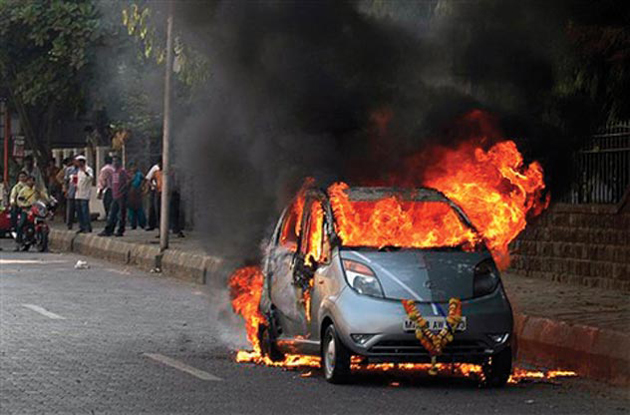
Tata Nano seems to be ‘firing’ constantly


The word fire seems to be haunting Tata Motors for some time now. Tata Motors have been working hard to insulate the rear seats of the Nano to cover the heat spread from its engine, which can be found behind the car’s rear seats. The most recent ‘firing’ was seen in Anand, Gujarat, where a Tata Nano reportedly caught fire.
Fortunately, none of the car’s occupants got hurt in the mishap and saw them exiting the car safely. There was smoke seen at the car’s rear and minutes later the whole car in flames, a scenario where the flames swallowed the car wholly. Proper reasoning behind the car catching fire is still unknown while the situation looks very similar to previous instances where the Nano caught fire on many occasions.
Apparently, the five occupants in the Nano spotted smoke coming from the car’s rear. The passengers sensed danger and immediately parked the car to the side and got off the car before the smoke turned into a large ball of fire taking the car with it.
Tata Nano seems to be firing constantlyInteresting to note is that there have been many incidents reported of the Nano catching fire in Gujarat and this being the second incident to be reported in Anand. Tata has been working hard to find a solution regarding these incidents. They did install additional material for fire-proofing in all the Nanos sold to date. They also ruled out defects in the Nano’s design after a thorough investigation regarding the fire incidents.
All these investigations done by Tata Motors appear to be futile as this was the 2nd time in less than 3 months when a Nano caught fire in Vadodara, most recently in June 2011. These incidents have not been doing any good to Tata’s image when it proclaims the Nano to be a safe car.
Currently, the Indian market is facing a crisis with a big sales dip noted by many manufacturers with Tata high on the list of sufferers. Furthermore, Nano sales have been very low while Tata Motors are finding new strategies to uplift its sales with measures like less down payment schemes and increasing its penetration in Indian market via SNAP (Special Nano Access Points) in order to find a way to get Nano sales moving. Incidents of the Nano catching fire regularly would only aid in depressing the sentiments of a buyer and prove to be very difficult for Tata Motors if they don’t find a solution or investigate the matter more thoroughly.
Lastly, they have to work transparently with their customers. Details of ongoing investigations should be made public on whether the Nano has a faulty design or the car indeed has serious issues with the engine. By doing so, transparency is the key to win back the hearts of its customers, which by all other means is really a good car considering the affordable pricing and other features.

AMAR

PGDM 2ND

Paul Edgerley | We’d like to be investors in Hero for 5-7 years and then we’ll exit


Building internal capability in R&D is part of the strategy and they (Hero) have made significant investments in it.
New Delhi: Bain Capital invested $550 million (Rs. 2,800 crore) in Hero Investment Pvt Ltd in March 2011. The money, a part of the Rs. 4,000 crore that the private equity firm invested along with Lathe Investment Pvt. Ltd—a unit of Government of Singapore Investment Corp. (Ventures) Pvt. Ltd (GIC)—helped the Munjal family-controlled Hero group fund its purchase of Honda Motor Co.’s 26% stake in Hero Honda Motors Ltd, now renamed Hero MotoCorp Ltd. Bain’s global managing director Paul Edgerley, who sits on Hero’s board, spoke in an interview about his firm’s partnership and expectations from the investment. Edited excerpts:
Why did you invest in Hero at a time when it was separating from Honda?
Investment goal: Edgerley says Bain Capital seeks to profit from partnering with Hero in developing in-house design and aiding its geographical expansion.
We always try to invest in situations where we feel like investing in companies that have a chance to become the market leader; and in this case, it already is a market leader.
We think that we can be a good partner in bringing in not only capital but actually can help the company in its evolution, although here is a well-established company that has got the best-in-class performance. It is going to go through significant transition with Honda leaving.
We think it is a company that will create larger shareholder value over the next five-seven years as it expands in export markets and continues to broaden its product line-up.
So it’s going to be in a situation where it needs to expand geographically and have a chance to think about bringing in design in-house. These are the areas where it would be an interesting transition for us to partner with them and help to expand the business and, hopefully, we will get an attractive financial return.
What kind of returns are you expecting from the transaction?
Generally, we target somewhere in the mid-20s kind of IRRs (internal rate of return) for any investments in that range. So it depends on how long we are going to hold the investments… so it could be two-and-a-half times the money in four-five years. (This is in line with Hero’s aim to cross $10 billion annual turnover in five-six years.)
            GAURAV KUMAR

PGDM 2ND