Thursday, March 29, 2012

Is India becoming a Marketing battlefield?


Is India becoming a Marketing battlefield?
Look at any industry out there and you will realize that slowly but surely India is getting hot with the war of the brands. There are a few prerequisites which any industry / company demands when entering a market. Some of them are market potential, buying power and the number of competitors.
Obviously, when companies started expanding in India around 1990 and 2000 they found a lot of market potential along with slowly increasing buying power, especially in the urban areas. Coming down to 2010, probably all companies have found out this one crucial secret – Indian consumers can buy their products by heaps.
Take electronics for Example – Samsung and LG are the David and Goliath of the electronics industry in India because of the the product range they have and their clout due to ATL and BTL Marketing. But lets break down their product range to each individual product and you will find that each product has individual competitors. Air conditioners will have Voltas, Washing machines will have Whirlpool, so on and so forth. Not only are the brands fighting on product range, they have to fight to market each product individually.
Take mobile handsets and you will find that within 2 years Nokia is practically out of the running. You may take any side if you want, but the culprit was Android. Just one wrong strategy – not partnering with Android and Nokia was hit badly. Loyalties were broken and new bonds were formed with smart phones which had android. That’s market sentiments for you.
For that matter, take Hollywood. Although I am not a movie buff, and I might not be able to get the data right here, but at least 10 Hollywood big brands are planning to release their movies in India first rather than anywhere else. So one things for sure, Not only Indian brands are battling for india, but the Indian market is even taking on the global market in entertainment too.
The fact is this – Indians brands better roll up their sleeves coz India is really becoming a battlefield. There would be a time when it would become hard to differentiate between an Indian and global brand and in that time, brand equity is the only thing which will count. Be wary of those days and start planning now.
GAURAV KUMAR
PGDM 2ND SEM
PGDM/11/14

Force India to appeal copyright case

Sepang: Force India said Sunday they would appeal for a higher pay-out after Caterham were found to have copied bits of their Formula One car, comparing the case to the explosive “Spygate” scandal.
The Indian team were awarded €25,000 ($33,200) in damages this week after a High Court judge in London found Caterham used Force India computer files stored at an engineering company when developing their debut car in 2009.
Force India were also ordered to pay €850,000 in unpaid fees to the engineering firm, Italy’s Aerolab. Deputy team principal Robert Fernley said the sum was deposited with the court long ago.
But he told AFP that Force India were “deeply disappointed” with their small pay-out, insisting that the copyright infringement had helped saved Caterham, formerly Team Lotus, millions of dollars in development costs.
Force India will ask for court permission to appeal the case, which first came to light from magazine pictures, and they will also refer it to the Federation Internationale de l’Automobile (FIA), the sport’s governing body.
In 2007, FIA fined McLaren $100 million and erased its constructors’ points for breaching Ferrari’s intellectual property rights in the infamous “Spygate” episode.
“We’ll appeal (in court) against all of the commercial side of it because we feel that the damages that were awarded is not representative of the cost of Formula One development,” Fernley said in an interview at the Malaysian Grand Prix.
“If you read into (the court judgement) there are admissions of copying on all aspects of (the car). And then there’s an admission on downloading all of those files and bringing them across into the UK and uploading them.”
Although the London court did not find evidence of systematic copying, Fernley said using Force India’s data as a shortcut had given Caterham a significant head-start in the costly world of Formula One.
He said a closely related case was also the subject of criminal charges in Italy after prosecutors there seized servers belonging to Aerolab, which has been engaged by both Force India and Caterham.
Fernley said Caterham had unveiled their car just two months after gaining entry into Formula One in September 2009, describing the swift turnaround as a “miracle”.
ForceIndia-Mercedes driver Paul di Resta (R) of Britain and ForceIndia-Mercedes driver Nico Hulkenberg (2nd R) of Germany power their cars along during Formula One’s Malaysian Grand Prix at the Sepang International Circuit in Sepang on Sunday. AFP
“To get to the level that is needed, Formula One is a huge amount of investment and time. Caterham took the Force India aero (aerodynamics) platform to get to a certain level which took them above HRT and Marussia,” he said.“But even three years on they’ve not progressed that. So it shows how difficult it is. So to be able to take, as the judge says, a shortcut, has enormous benefit.
“First of all it saves you millions of pounds and secondly it puts you straight into position.”
Caterham has finished 10th in the constructors’ standings, above HRT and Marussia, in both its two seasons so far. It has not commented directly on the case, although its lawyers called the outcome “very satisfactory”.
Fernley said the case came to light when Force India saw magazine pictures showing their Bridgestone tyres on Caterham’s new car. On further inspection, parts of the car also looked familiar.
“In November 2009 pictures of the Team Lotus model were put into the magazines. And the thing that drew our attention to that was actually the tyres. They had used Force India’s Bridgestone tyres on that model.
“But when we looked at the model closer it also looked like other things had been copied. So we asked Team Lotus, is there anything you’d like to share with us?”
While Force India are at pains not to be put pressure on FIA, Fernley said the governing body’s reaction to the case could have important ramifications for Formula One.
“There’s some very interesting scenarios you could play with. If nothing is done and that accepts that copying is OK, that means a free-for-all in the paddock,” Fernley said.
“Equally if nothing is done, could McLaren claim their $100 million back? If the FIA decide it’s something they have to look at and they do sanction against Caterham, it could cost Caterham tens of millions.”
The FIA was not immediately available for comment.


Saket Kumar
Pgdm2ndsem.
Pg,11,42

Profiling of institutional cash pools


 Profiling of institutional cash pools

Through the profiling of institutional cash pools, this paper explains the rise of the "shadow" banking system from a demand-side perspective. Explaining the rise of shadow banking from this angle paints a very different picture than the supply-side angle that views it as a story of banks’ funding preferences and arbitrage. Institutional cash pools prefer to avoid too much unsecured exposure to banks even through insured deposits. Short-term government guaranteed securities are the next best choice, but their supply is insufficient. The shadow banking system arose to fill this vacuum. One way to manage the size of the shadow banking system is by adopting the supply management of Treasury bills as a macroprudential tool.
Excerpts
"...institutional cash pools prioritize principal safety and portfolio diversification over yield and are hesitant (in many cases due to fiduciary reasons) to take on too much direct, unsecured exposures to banks through even insured deposits. In other words, institutional cash pools are not particularly keen on being intermediated through the traditional banking system."
"In the present context, Treasury bills (or more broadly, short-term government guaranteed instruments) are like gold. Just as in the 1960s there were too many dollars relative to U.S. gold reserves, today there is too much demand for safe, short-term and liquid instruments relative to the volume of (i) short-term, government guaranteed instruments; (ii) high-quality collateral to “manufacture” alternatives to short-term, government guaranteed instruments (see Bernanke (2011)); and (iii) capital to support the safety, short maturity and liquidity of such alternatives (see Acharya and Schnabl (2009)). All of these aspects have global dimensions:
First, one reason for the increase in the structural deficit of short-term, government guaranteed instruments is that reserve accumulation and foreign exchange management vis-àvis the dollar is primarily conducted by foreign central banks through the accumulation of U.S. government guaranteed securities, including short-term government guaranteed securities. However, these instruments are also the first-resort investment choice of cash pools.
Second, the high-quality collateral requirements associated with the manufacturing of alternatives to short-term government guaranteed instruments is also influenced by foreign central banks’ accumulation of long-term U.S. government guaranteed securities. For example, a shortage of Treasury bills can be filled by lending cash in a short-term repo transaction backed by longer-term Treasury notes. However, if the supply of high-quality term collateral becomes scarce, either (i) private alternatives (such as asset-backed securities and CDOs) will take their place (see Caballero (2009) and Bernanke (2011)), or (ii) the velocity of high-quality collateral will accelerate (see Singh (2011c, forthcoming)) if demand for the manufacturing of more safe, short-term and liquid instruments persists
Third, the transformation of term private collateral into safe, short-term, liquid instruments requires the performance of credit, maturity and liquidity transformation, which were conducted across a highly diverse set of institutions in the “shadow” banking system and backstopped by a diverse set of banks globally.
These examples demonstrate that not unlike the soaring volume of U.S. dollars relative to the volume of U.S. gold reserves stretched the convertibility of the dollar in the 1960s, the rise of institutional cash pools and their safety preferences stretched the U.S banking system to its limits in its ability to guarantee cash pools’ principal safety and redeemability on demand and at par and in unlimited amounts and in all states of the world. The U.S. banking system failed at a task no less than endogenously creating private alternatives to Treasury bills, that had the same degree of safety and liquidity than the real T-bills that were in short supply."

VIKASH KUMAR SINHA 
PGDM 2ND
PGDM/11/49


What is indemnity ?


Undertaking given to compensate for (or to provide protection against) injury, loss, incurred penalties, or from a contingent liability. A shipping company, for example, will ask for a bank's indemnity for releasing a shipment to a consignee who has lost original shipping documents. The bank in turn will require the consignee to sign a counter-indemnity before issuing its indemnity to the shipping company. This way the consignee gets the release of shipment in completion of a transaction, and both the shipping company and the bank are protected in case some dispute arises out of that transaction. See also letter of indemnity
By:
Manoranjan Kumar
PGDM 2nd.

Deccan Chargers scouting for more sponsors after Emirates

The team is hoping for a revival in fortunes after a “little drop” in sponsorship revenue in last year’s season

Hyderabad: Deccan Chargers, the cricket team owned by publisher Deccan Chronicle Holdings Ltd, said it will sign up more sponsors after it chose Emirates as the team sponsor on Wednesday, replacing Ultratech Cements Ltd, for the fifth season of the Indian Premier League (IPL) that begins on 4 April.
Deccan Chargers is close to signing up three new sponsors, said E. Venkatram Reddy, chief operating officer of the IPL team, without disclosing names. Dubai-based Emirates will be the team sponsor of Deccan Chargers for the next three seasons, he said.
New backing: A file photo of the Deccan Chargers team at the Rajiv Gandhi stadium in Bangalore. Photo by Hindustan Times
Emirates chose Deccan Chargers after its three-year sponsorship contract with Kings XI Punjab lapsed. The Dubai-based airline chose the Hyderabad team over other teams as it operates three flights from the southern city, said Roger Duthie, head of sponsorships at Emirates. The sponsorship will give Emirates access to the team’s players for its promotional activity and will be entitled to display its logo on the team apparel, stadia branding and match tickets.
“Over the years, we had a wonderful relationship with the Kings, they were great organization and I have complete respect for the Kings but there was a time when we needed an online team,” Duthie said, meaning a team based out of a city where Emirates runs operations from. He did not disclose the value of the deal.
Puma AG, Kingfisher, Mc Dowell’s No.1, Linc Pens, news channel TV5, BIG FM 92.7 and Apollo Hospitals Enterprise Ltd also sponsor the Deccan Chargers currently.
Deccan Chargers is hoping for a revival in fortunes after last year’s IPL season, when it saw a “little drop” in sponsorship revenue.
The Hyderabad-based franchisee is focusing on a brand revival strategy and will play matches in other cities, including Visakhapatnam and Cuttack, to spread its base. Reddy said tickets are sold out within 48 hours in Visakhapatnam.
“This means they will get more revenues from these cities,” said an analyst with a large advertising media company, who did not want to be named as he works with the IPL franchisees.
“It makes sense for them to do it. You have got relatively large cities around Hyderabad. Bangalore and Bombay are filling up stadiums for all the matches because there is a large population coming in,” he said over telephone.
Reddy also denied reports of a stake sale in Deccan Chargers, saying the franchisee had posted growth of 15-20% over the previous year.
“Deccan Chargers is a brand of Deccan Chronicle. It is a part of the company. How will we sell it?” he said.
Shares of Deccan Chronicle Holdings fell 5.43% to end trading at Rs34.80 on a day the benchmark Sensex lost 0.79%.
Deccan Chronicle Holdings publishes the Deccan Chronicle and the Financial Chronicle, which compete with HT Media .


Saket Kumar
Pgdm2ndsem.
Pg,11,42

Marketing Mix DELL


Dell is one of the leading Consumer durables brand. The marketing mix of dell talks about the way in which dell has improvised to gain a competitive position.

Product:
  • Dell believes that, ‘Marketing is not about providing products or services it is essentially about providing changing benefits to the changing needs and demands of the customer’.
  • Dell provides a wide variety of both business class and home/consumer class products and services.
  • Dell designs, develops, manufactures, markets, sells, and supports a wide range of products that in many cases are customized to individual customer requirements.
  • A few examples of products for individual and professional customers are Dell Precision workstations, OptiPlex desktops, Dimension desktops, and Inspiron and Latitude notebooks.
Price:
  • Pricing strategies usually change as the product passes through its life cycle, because there is constrains on the company’s freedom to price a product at different stage.
  • The main objective of Dell is to produce the low price and profitable PC for the customers.
  • For the above reason Dell’s product pricing reflects the affordability of the local consumers.
  • Because Dell products are so customizable, the price is largely dependent on the options and services added to the product.
  • Dell is undercutting competitors in price to rapidly gain market share.
Place:
  • Place is also known as channel, distribution, or intermediary. It is the mechanism through which goods and/or services are moved from the manufacturer / service provider to the user or consumer.
  • Dell has been able to affect the location strategy aspect of its marketing campaign.
  • As Dell’s products are always available at the nearest dealer’s customers develop trust for the “local Dell” thereby achieving the objective of gaining their trust in Dell products and services, and forming a large and diversified consumer base.
Promotion:
  • Another one of the 4 P’s is promotion. This includes all the tools available to the marketer for ‘marketing communication’.
  • Dell in the past have not concentrated on extensive marketing campaigns but these revolutionaries in 1999 when Dell changed its tactics by engaging in extensive marketing campaigns.
  • Dell markets its products primarily by advertising on television and the Internet, advertising in a variety of print media, and mailing or emailing a broad range of direct marketing publications, such as promotional materials, catalogs, and customer newsletters.
  • Dell has recently started promoting its products through retailers like Best Buy, Staples, Wal-Mart, GOME, and Carrefour.
Mayank Mittal
PGDM-2nd sem
PGDM-11/22

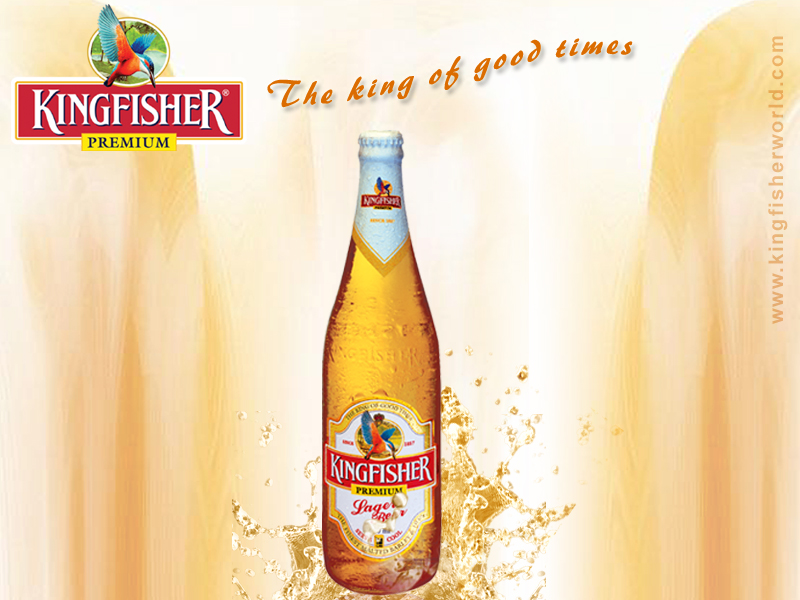
Kingfisher : The King Of Good Times

Brand: Kingfisher
Company: UB Group
Agency:JWT

Brand Count :169

Kingfisher is a classic case of branding success. This brand can even be termed as an iconic brand. A brand that had extended itself from beer to airlines can be equated to the Virgin brand. The brand is synonym with Beer in India. Now ask a young man from India what a Kingfisher is ? The most likely answer will be either Beer or Airline. The power of the brand has virtually made the bird a brand extension.

Kingfisher is a brand from the UB group stable.It is the largest selling beer brand in India commanding a market share of over 28% in the Rs 5000 crore Indian Beer market.The brand epitomises energy, youthfulness ,enthusiasm ,freedom but with a touch of professionalism.

United Breweries (the original name of the group) have a history dating back to 1857. The company came into existence as UB in 1915 with the merger of five small breweries . The Kingfisher brand was launched in the year 1980 ( the exact year of the birth of Kingfisher is not known,80's marked the real life of this brand).

The brand was the brain child of the current Chairman of UB group Mr Vijay Mallya. Reports says that Mr Mallya went to work in Calcutta as a part of mentoring program under Mr HP Bhagat. At that time the brands that were popular from UB stable was Kalyani Black label, Doctor's Brandy etc. Mr Mallya wanted to create an exciting brand and none of the existing brands did not impress him. He went back to Bangalore,searched archives and stumbled upon an old label with a Kingfisher in it. That marked the birth of the Iconic Kingfisher brand.

The major factor behind the success of Kingfisher brand is the Passion that Mallya have on the brand. When marketing theorists says that Marketing is a serious business, Mallya will tell you that Marketing is CEO's business. When the CEO takes interest in the brand and virtually promotes the brand in every occasion, there is so much equity generated on the brand. Like Virgin's legendary Richard Branson , Mallya also showed that the primary task for any CEO is to be passionate about the brand. While in most cases CEO comes into picture to deliver the annual shareholder's meet, Mr Mallya takes the brand with him everywhere.

Kingfisher brand is a unique marketing success story because it thrived in an environment where liquor/ beer advertising was banned in India. The owners have built the brand circumventing the ban on promotion. During 1997 , the brand roped in Ajay Jadeja and Sourav to feature in the campaigns. In 1996 the brand become the worldwide sponsors of the West Indies cricket team. But the brand was conscious to keep Kingfisher the star . The West Indies team personified the brand values of fun loving but successful team. The famous jingle " Oola la le lo" and the fun filled TVC rightly placed the brand as a fun loving one. Unlike brands like Pepsi which is focused on cricket, Kingfisher promotes all sports and the brand sponsors football stars and even Formula 1.

The brand directly talks to people who are Easy going, chilled out person who's always willing to take a break and party with the friends. But they are very professional and successful .

Most of the business reports try to relate the persona of Mr Mallya and the brand which I feel is unjustified. The brand Kingfisher does not derive any thing from the personality of Mr Mallya. The brand has its life of its own. Since the chairman is passionate about the brand, he takes personal interest in the brand . Other than that relating the person and the brand and trying to say that Mr Mallya is more flamboyant than the brand is doing unjust to the brand.
By:- Prakash Yadav (PGDM 2nd sem)